Automotive assembly and component production place strong demands on sequence control, fixture repeatability, operator guidance, part verification and traceability. Automation does not have to mean replacing every manual step. Many high-value improvements come from controlling the way people, tools, sensors and software interact at the workstation.
Error-proofing starts with the process sequence
A poka-yoke strategy should identify what mistakes are possible, when they can occur and which confirmation method is appropriate. Sensors, barcode readers, RFID, machine vision, torque tools and fixture detection can all be used, depending on the operation.
Guided assembly supports mixed-model production
Recipe-driven work instructions can show the correct component and sequence for the current variant. When connected to verification devices, the system can prevent progression until the required condition is satisfied.
Fixtures and tooling remain critical
Software cannot compensate for unstable product location. Fixtures, nests, clamps, locators and tooling should provide repeatable mechanical conditions while allowing safe loading, ergonomic access and maintainability.
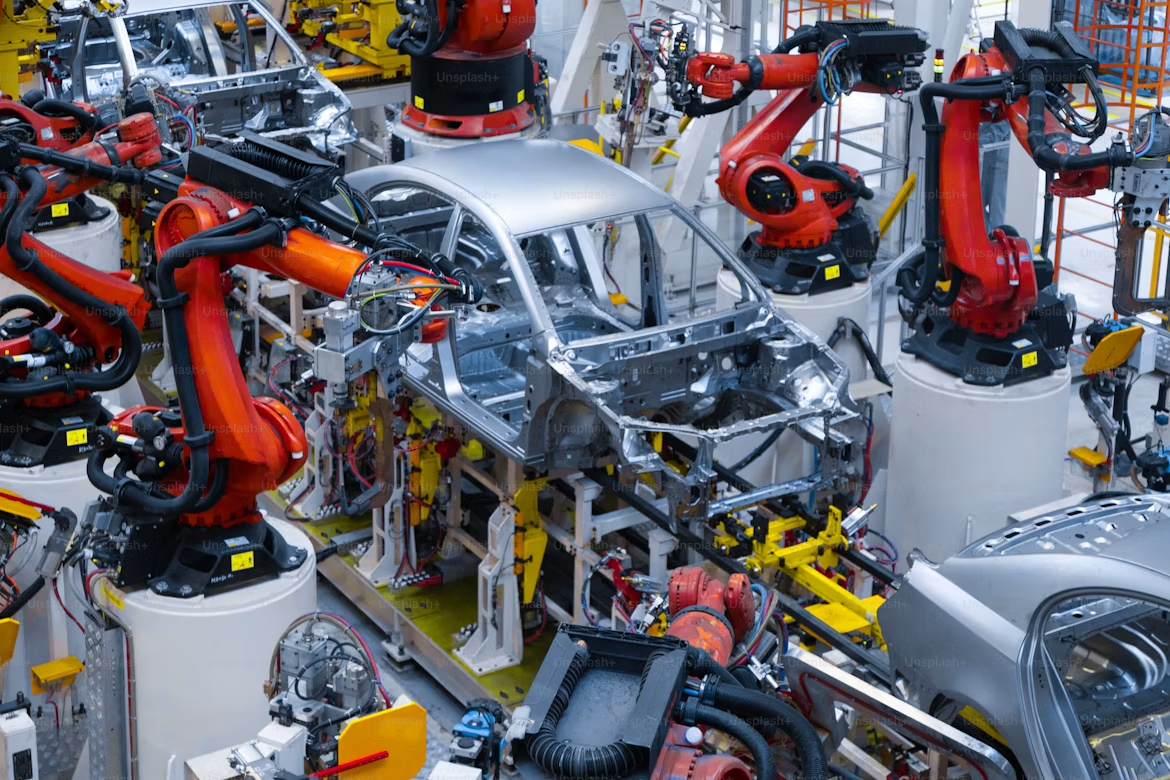
Robotics where repetition and consistency justify it
- Component loading and unloading
- Machine tending
- Adhesive, dispensing or process applications
- Material handling between stations
- Selected assembly operations
- Vision-guided inspection or handling
Traceability links process results to the product
A useful traceability record can include product identity, recipe, operator, fixture, station, completed steps, inspection results and timestamps. The right level of data depends on customer requirements and should be defined before software architecture is finalized.
RoboMecs assembly-system capability
RoboMecs combines mechanical fixtures, PLC integration, Cognex-class machine vision concepts, barcode and identification devices, guided-assembly software, sequence poka-yoke and traceability architecture. This creates a strong foundation for manual, semi-automatic and robotic assembly stations.
A practical implementation path
- Define the product variants and critical assembly sequence.
- Identify quality escapes and poka-yoke opportunities.
- Engineer fixtures, sensors and tool interfaces.
- Build the PLC and supervisory software boundary.
- Validate the station in simulation or offline testing where practical.
- Commission with real operators and capture recovery scenarios.
For a new or existing assembly station, share the process flow and quality requirements with RoboMecs. We can help define whether the best solution is mechanical poka-yoke, controls, vision, software, robotics or a combination.