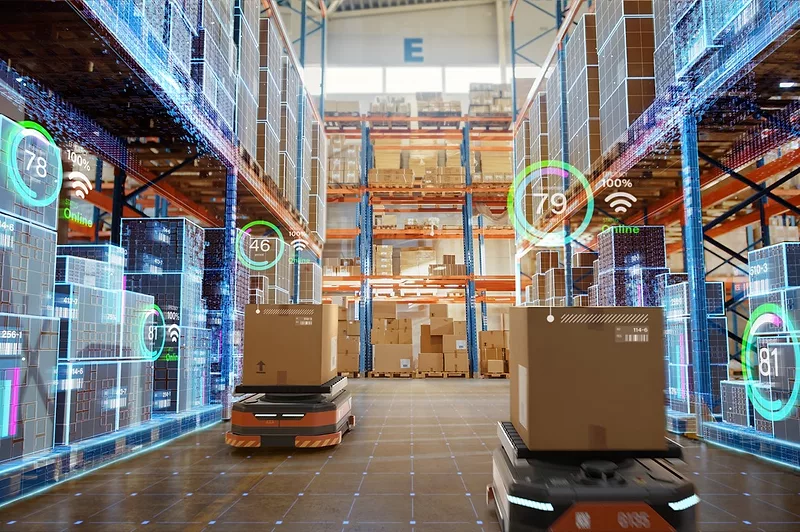
Warehouse automation is most effective when the technology is selected after the flow is understood. Order profile, SKU characteristics, inbound and outbound peaks, storage strategy, pick method, replenishment and dispatch rules all influence whether conveyors, AMRs, sortation or automated storage are appropriate.
Map the flow before choosing technology
- Receiving and inbound staging
- Putaway and replenishment
- Storage and retrieval
- Picking or goods-to-person movement
- Consolidation and sortation
- Packing and labeling
- Outbound staging and dispatch
Conveyors for predictable, repeated flow
Conveyors are strong where material follows stable routes at consistent volume. They can provide high capacity and deterministic movement for cartons, totes and pallets, especially between fixed process areas.
AMRs and AGVs for flexible transport
Mobile robots can reduce fixed infrastructure where routes change, destinations are distributed or phased expansion is important. Fleet sizing should consider travel distance, mission time, charging, traffic, pickup/drop-off service time and peak demand.
Sortation and routing
Sortation systems require reliable identification, controlled product spacing and clear destination logic. Throughput should be evaluated at the whole-system level, including induction, recirculation and downstream capacity.
Warehouse Control System interfaces
A WCS or supervisory layer can coordinate equipment tasks and exchange information with WMS or ERP systems. The interface should define job creation, status, exceptions, inventory events and what happens when communications are interrupted.
Automation can be phased
Not every warehouse needs a fully automated end state on day one. A phased plan may start with the highest-volume transport or sortation constraint while preserving the layout and control architecture for future automation.
RoboMecs warehouse integration
RoboMecs brings conveyor engineering, industrial controls, mechanical integration and software interfaces into warehouse-automation projects. This is useful when fixed conveyors, robotic handling and mobile systems must connect to one operational flow. Share your warehouse layout and volume profile for an initial automation discussion.