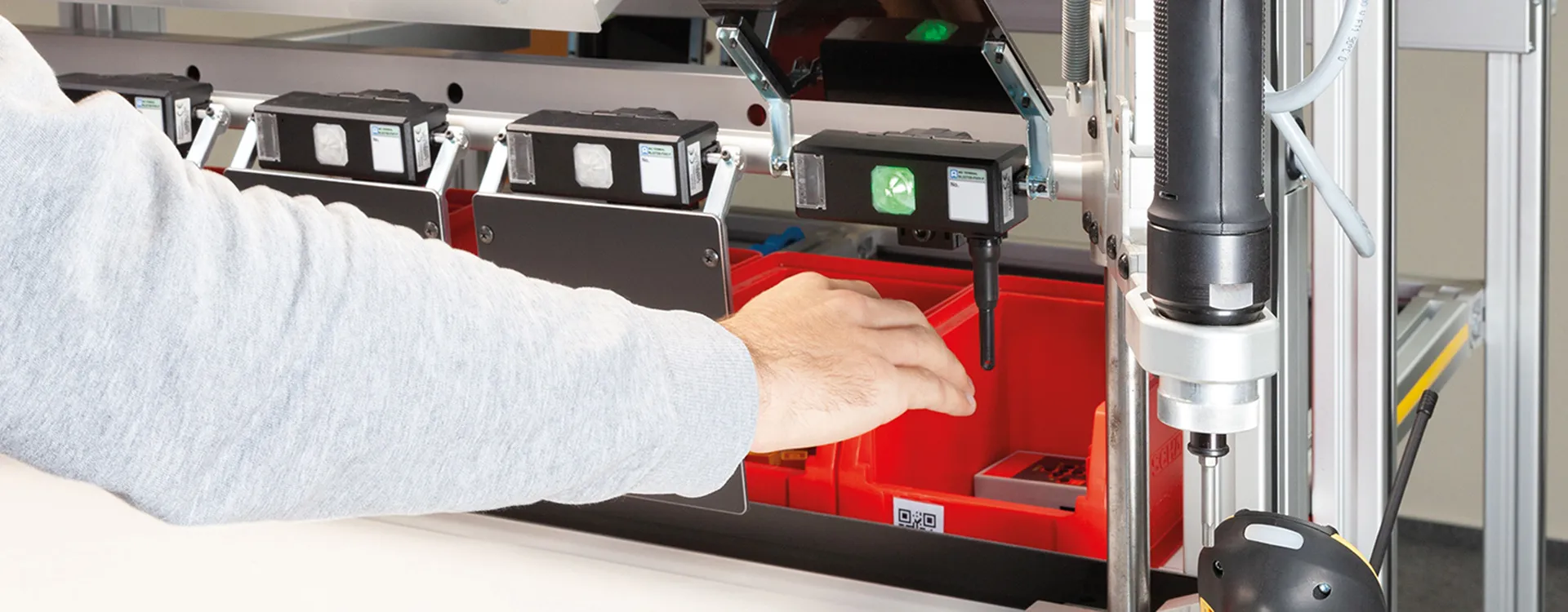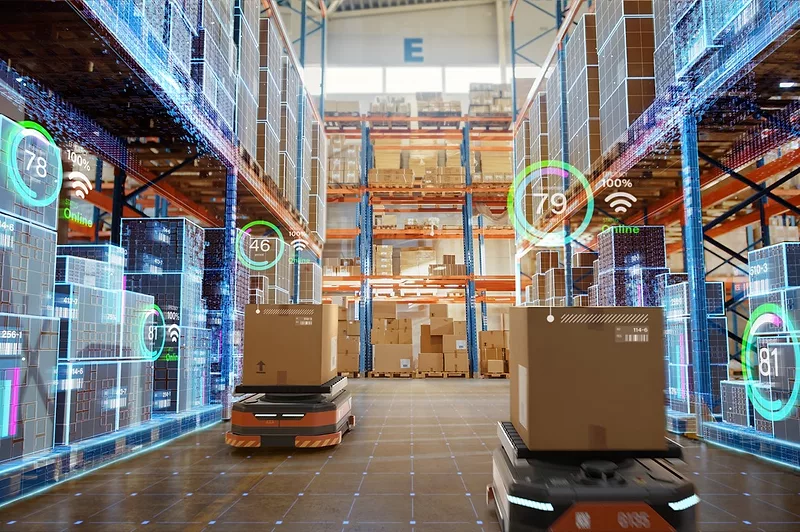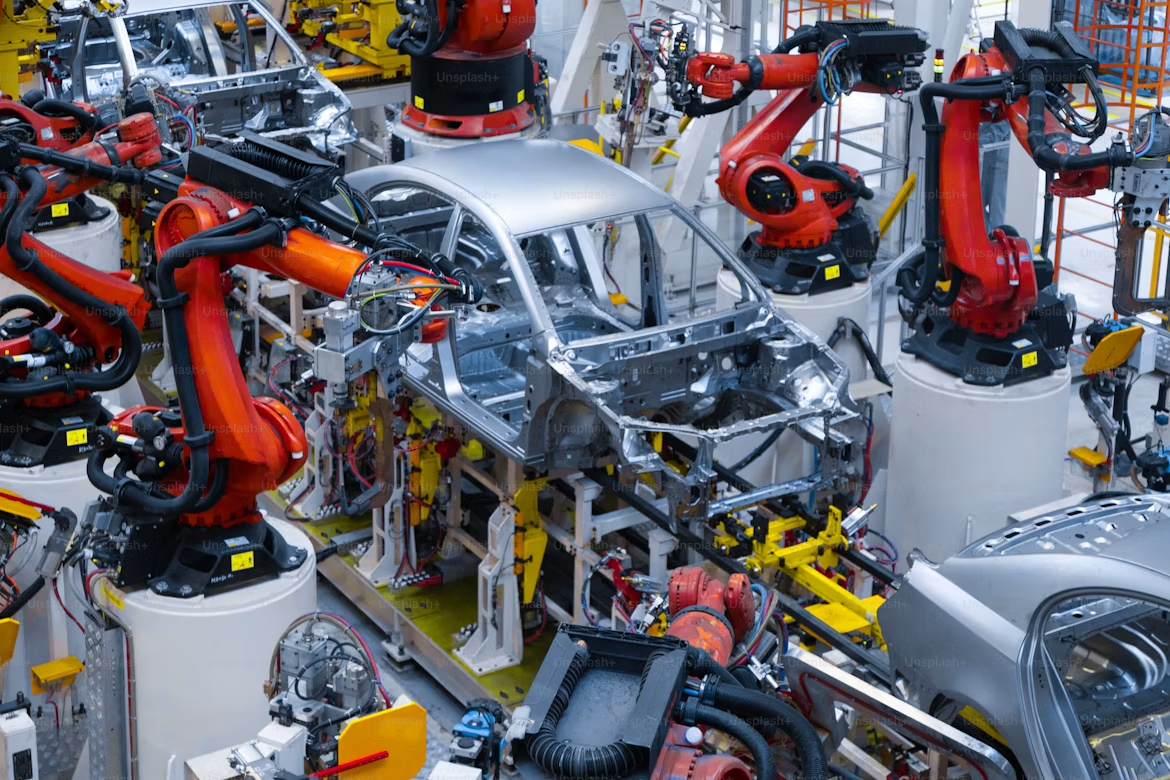
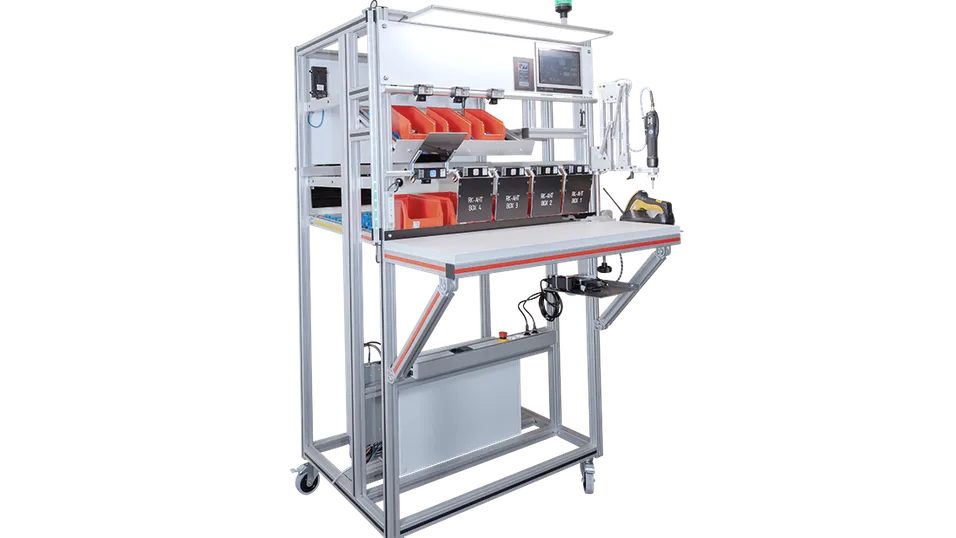
Manual assembly is valuable because people can adapt to product variation, mixed models and tasks that are difficult to automate economically. The weakness appears when quality depends on memory, paper instructions or inspection after the mistake has already happened. A modern poka-yoke station keeps the flexibility of manual work while controlling the sequence and verifying critical conditions before the product moves forward.
What poka-yoke should prevent at an assembly station
- Wrong product or recipe loaded at the station
- Wrong component selected or scanned
- Component installed in the wrong position
- Required operation completed out of sequence
- Incorrect fixture or tooling used for the product variant
- Critical inspection step skipped
- Product released without a complete production record
A layered architecture is stronger than one verification method
Reliable mistake-proofing usually combines several confirmation methods. The right architecture assigns each device a clear responsibility and avoids asking one sensor or camera to solve every quality problem.
| Layer | Typical role | Engineering consideration |
|---|---|---|
| Product identification | Barcode, serial number or RFID loads the correct recipe | Identity must be validated before assembly begins |
| Fixture and sensors | Confirm seating, presence or discrete physical conditions | Sensor state should be linked to a clear process interlock |
| Machine vision | Verify product, component, orientation or final visual condition | Lighting, field of view and failure recovery must be engineered |
| PLC control | Own machine interlocks, deterministic I/O and equipment states | The PLC should remain the real-time authority for machine control |
| Guided software | Show work instructions, sequence, recipes and operator prompts | The software should make the next required action unambiguous |
| Traceability | Store cycle identity, steps, results and timestamps | Data should support quality investigation without slowing production |
A practical sequence for controlled manual assembly
- Identify the product and automatically load the approved recipe.
- Verify the required fixture or tooling before product loading.
- Guide the operator to the current assembly step.
- Confirm the required component or condition using barcode, sensor, vision or tool feedback.
- Allow the PLC and supervisory software to advance only when mandatory checks are satisfied.
- Complete final inspection and store the cycle record for traceability.
What the operator should see
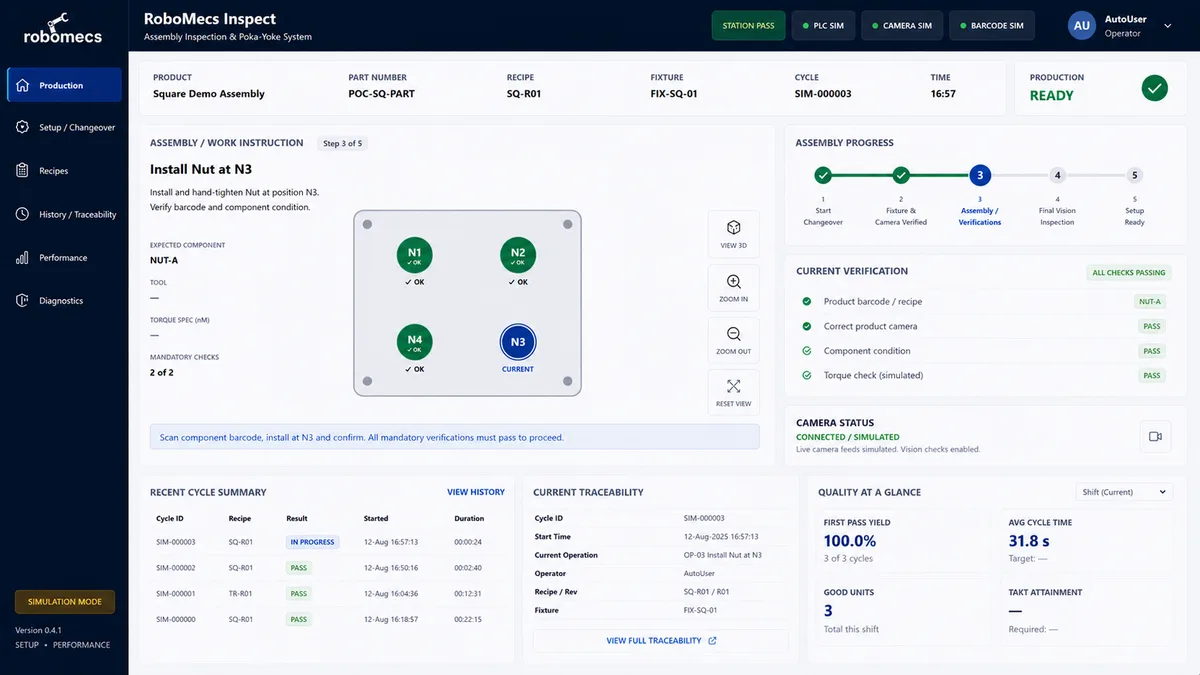
The operator interface should not look like an engineering diagnostic screen. It should clearly show the current product, recipe, fixture, required task, expected component, verification status and what must happen next. Engineering settings and commissioning tools should remain available to authorized users without cluttering normal production.
How vision fits into poka-yoke
Machine vision is useful when the quality condition cannot be confirmed reliably with a simple sensor. Typical checks include product identity, component presence, orientation, position, fixture recognition and final assembly inspection. Vision should be applied where it adds clear value, with a defined response for no-read, fail and communication-loss conditions.
Traceability turns verification into usable production history
A controlled station can record product identity, recipe revision, fixture, completed operations, verification results, timestamps and final disposition. That information helps quality teams investigate failures and gives engineering a factual view of how the assembly process is performing.
Where to start on an existing manual line
- Map the current assembly sequence and identify the mistakes that create the highest quality or rework risk.
- Separate conditions that need mechanical poka-yoke from those better verified by sensors, vision, barcode or tool feedback.
- Define which checks are mandatory and which conditions require supervisor recovery or controlled override.
- Design the PLC, vision and supervisory-software interfaces before selecting the final screen layout.
- Validate the workflow with real operators and include fault recovery, wrong-component and wrong-sequence scenarios.
RoboMecs approach to assembly poka-yoke
RoboMecs combines fixture engineering, industrial controls, machine vision, barcode and identification devices, guided assembly software and traceability into one station architecture. The objective is not to add technology for its own sake. It is to create a production process that is easier to follow, harder to execute incorrectly and easier to investigate when something goes wrong. Discuss your manual assembly or poka-yoke requirement with RoboMecs if you want the station reviewed as a complete mechanical, controls and software system.