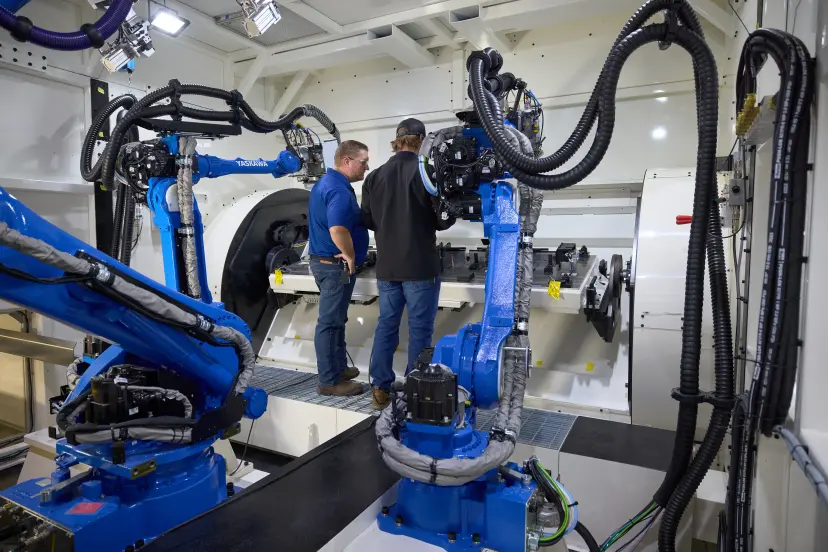
Industrial robots from leading manufacturers are proven technologies. Project risk usually comes from the application around the robot: the tooling, product presentation, controls, safety, cycle-time assumptions, commissioning and how the cell connects to production. That is why integrator selection is a critical procurement decision.
1. Does the integrator start with the process or the robot brand?
A strong integrator should first understand product data, required output, layout, quality requirements, operator interaction and surrounding equipment. Robot model selection should follow the application definition.
2. Who owns cycle-time validation?
Ask for the assumptions behind throughput. A credible cycle-time model includes pick and place motion, gripper actions, conveyor timing, vision, product availability, pallet changes and downstream constraints.
3. Can the same team engineer EOAT, fixtures and mechanical interfaces?
Robot reliability depends heavily on tooling. If EOAT, fixtures and guarding are outsourced without clear interface ownership, commissioning risk can increase.
4. Who owns PLC, HMI and line integration?
The robot controller is not the complete control system. Production machines need clear interlocks, recipes, fault states, recovery sequences and operator diagnostics.
5. How is safety engineered?
Ask who performs the risk assessment, defines safety functions and validates access, guarding and operating modes. Safety should be part of concept design, not an accessory added after the layout is fixed.
6. What happens when the process stops?
A good proposal describes recovery, not only normal operation. Operators should be able to understand where the sequence stopped and how to restore production safely without unnecessary specialist intervention.
7. Can the system handle product changeover?
Ask how recipes, tooling changes, vision parameters and pallet patterns are managed. Routine SKU changes should be planned during engineering rather than solved during commissioning.
8. What evidence exists for local field support?
Commissioning and post-startup support are especially important for Saudi industrial sites. Clarify response expectations, spare-parts strategy, remote access policy and who can attend site when required.
9. Is documentation part of the deliverable?
- Electrical drawings and I/O documentation
- PLC/HMI and robot program backups
- Mechanical drawings and spare-parts lists where applicable
- Operating and recovery instructions
- Risk assessment and safety documentation as agreed
- FAT/SAT records and training material
10. Does one party own the complete system boundary?
When robotics, conveyors, controls, vision, fabrication and software are purchased separately, the customer can become the system integrator. A single accountable integrator can reduce interface gaps if that company genuinely has the required engineering breadth.
RoboMecs combines robotic, mechanical, conveyor, controls and software disciplines for integrated projects. Send us your RFQ or application details if you want an engineering review before finalizing the automation concept.